You choose seats near the door without even thinking about it now.
Stedara
Calm. Guided. Built for hard-to-leave moments.
Exhausted by planning every exit around urgency?
Most urgency strategies ask you to manage harder. Stedara adds a discreet device-assisted option that works without visible effort in hard-to-leave moments.
I stopped choosing my seat based on where the exit was. Female, 52, works in finance.
For people who plan ahead, choose seats near the door, keep backup measures in mind, and want more confidence when leaving the situation is not simple.
Designed for people seeking more practical control in hard-to-leave situations such as meetings, travel, formal events, and other times when repeated disruption can be difficult.
Stedara is a guided program designed to help you test one practical, self-directed option for the situations that matter most.
- Built around real trigger moments
- Screening before payment
Screening applies before payment so people can move forward in a way that is considered and appropriate to their situation.

Does this feel familiar?
It’s not always about constant leakage. Often, it is the spike of urgency in the moments you cannot easily leave, and the pressure that can come with that.
You have had to step out of a meeting and found it hard to settle back into the rest of it.
You scan trains, buses, venues, or aircraft for how quickly you could get out.
You avoid workshops, long sessions, or unfamiliar venues unless you know the toilet plan first.
You rely on backup measures, but still want a better option for times when leaving is not simple.
You want to explore whether there may be another option for those specific situations.
If backup measures are already part of your planning and you wish they were not doing so much of the work, you are not alone. For some people, this may offer another option to consider in selected situations.
The goal is not perfection. It is fewer panic exits, less disruption, and more confidence in the moments that matter.
The Method
The thinking behind Stedara Method
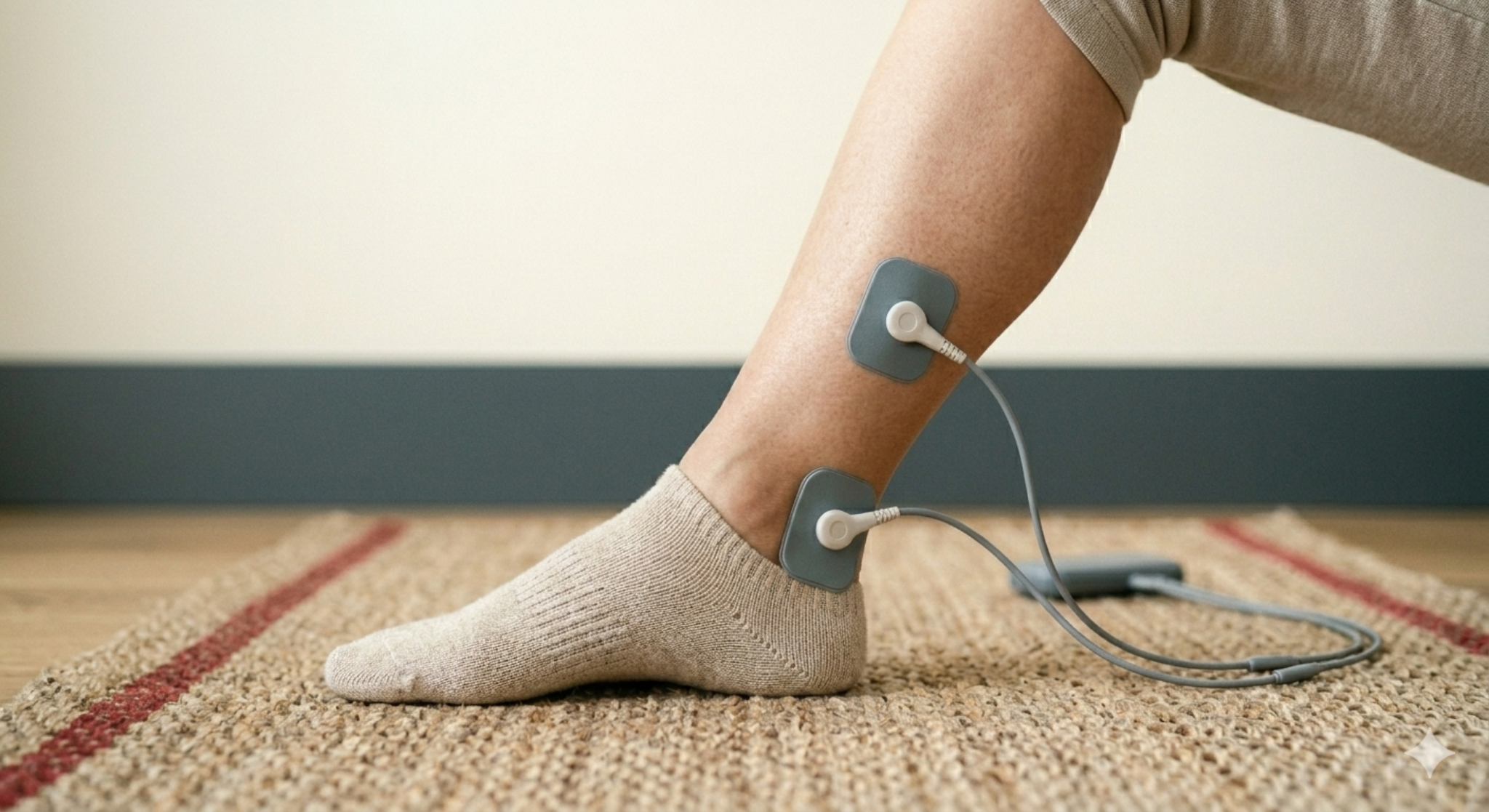
Stedara Method draws on Trans Tibial Nerve Stimulation, or TTNS, an approach used in overactive bladder care. TTNS uses a standard TENS unit with electrodes placed near the inside of the ankle, where stimulation is applied near nerve pathways also involved in bladder function.
Stedara is a guided method informed by this principle and designed for selected hard-to-leave situations. This landing page explains the idea at a high level. The full Stedara method is provided only inside the program after screening.
Example placement
A quick check on whether Stedara may suit you before screening
If you want a clearer sense of whether Stedara may suit you before starting the formal eligibility and safety check, this short pre-screen can help.
It is intended as a private first step to help you decide whether moving to the formal screening process makes sense.
Likely a fit if
Worth pausing if
How to use this: This is not a diagnostic tool. It is a simple first check to help you decide whether it makes sense to move to the formal eligibility and safety screening.
Where it matters
Built for the moments where leaving is hard
Stedara is designed around the situations that often feel hardest to manage: the ones where stepping out is difficult, inconvenient, or not really under your control.
For the right person, the value is practical. It is feeling more settled, less interrupted, and more confident in the moments that matter.
Meetings and interviews
Stay more present when leaving mid-session feels visible or disruptive.
Training and workshops
Long seated sessions where frequent exits can feel awkward or distracting.
Flights and delays
Externally controlled settings where you cannot simply step out whenever you want.
Public transport and waiting periods
Moments where timing, privacy, and limited control make urgency feel heavier.
Practical fit
Designed to sit discreetly under ordinary workwear
The setup is built for low-visibility use with suitable clothing, equipment, and placement. In work settings such as seated meetings, workshops, and desk-based periods, it can be arranged to stay out of sight and out of the way.
Ordinary workwear can provide practical concealment: a trouser leg routes the wire, a pocket or waistband holds the unit, and the setup remains discreet through normal workplace moments.
This is not about promising invisibility in every outfit. It is about showing realistic workwear examples that support discretion in daily life, with fit depending on your clothing, body, device, and situation.
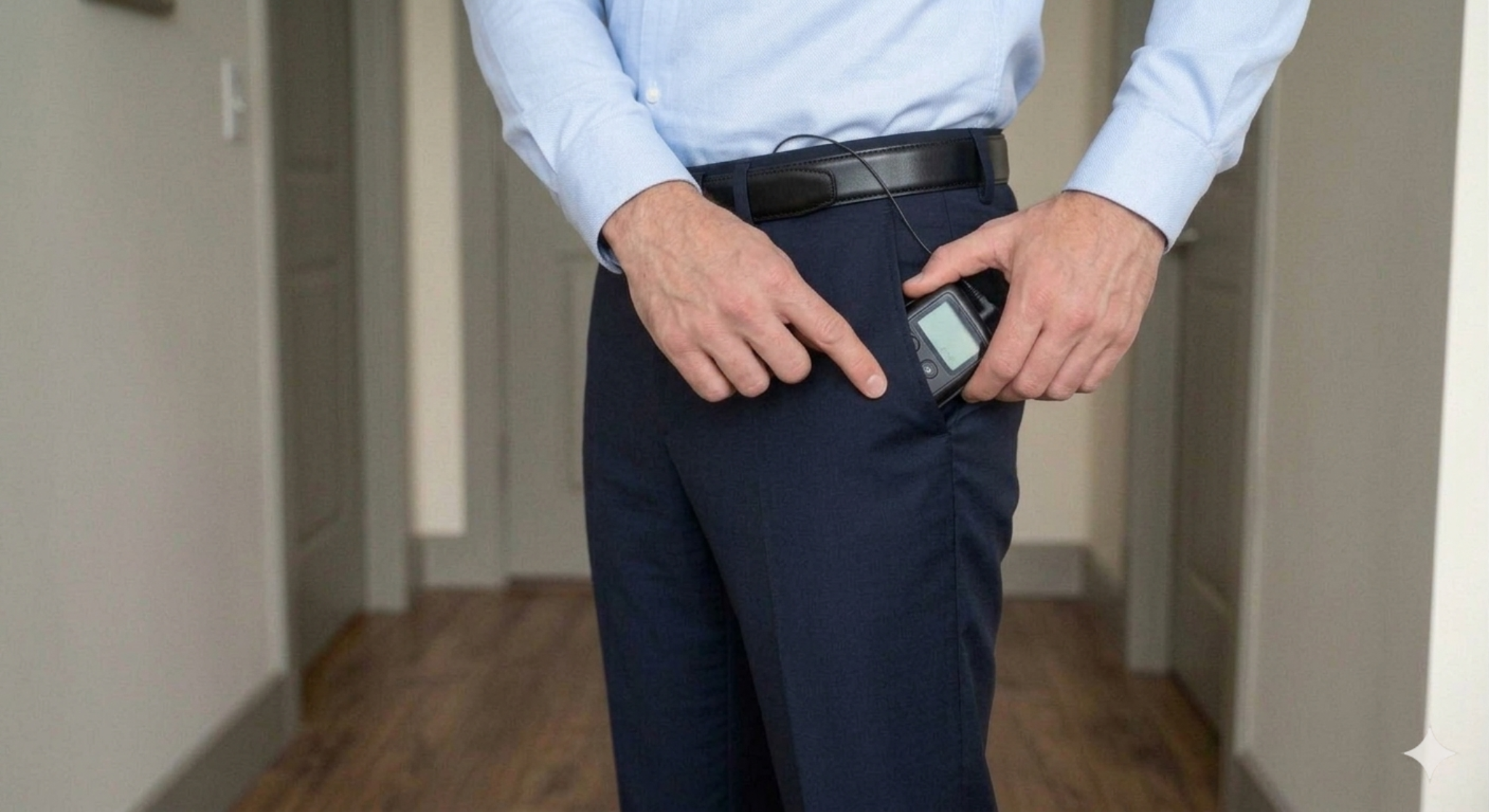
Example workwear setupOne example of how a TENS unit may sit within suitable business clothing during everyday use.
Likely fit
Who this is most likely to suit
- Your main issue is urge incontinence or urinary urgency rather than stress leakage.
- Urgency tends to spike in predictable situations or time periods.
- You can identify a consistent 1-3 hour trigger moment to track.
- You are willing to complete baseline tracking and follow the process consistently.
- You are comfortable sourcing your own TENS unit with general feature guidance provided.
Worth pausing
Worth pausing before you proceed if
- Stress incontinence is your primary issue, such as leakage with coughing, sneezing, lifting, or exercise.
- You have new, unexplained, unassessed, or worsening urinary symptoms.
- You have blood in your urine, painful urinary symptoms, signs of infection, or difficulty emptying your bladder.
- You are pregnant, have an implanted electrical device, or have another reason a TENS unit may be unsuitable for you.
If you are unsure whether your symptoms fit this program, seek medical review before going further.
Access
What you get and how access works
People usually come to this because certain situations feel hard to manage, hard to leave, and difficult to navigate with confidence. They are looking for a guided option to explore whether those moments can feel more manageable.
What you receive
- Required screening and safety check before payment — so access is limited where the program appears suitable based on self-reported responses, exclusions, and safety criteria.
- Guided 3-week method pathway — with a clear start point, practical tracking, and a defined review point.
- Simple prompts built around your own trigger situation — meetings, flights, public transport, workshops, or other repeatable situations.
- Step-by-step instructions unlocked after the safety check — so you can set up consistently and track change.
- End-of-period summary and next-step guidance — to help you decide what is worth continuing.
- Discreet administrative support — help with access and platform use, not clinical advice.
Screening remains mandatory. Screening is based on self-reported responses, exclusions, and safety criteria. It does not diagnose conditions, predict outcomes, or replace medical assessment.
Read before you decide
A clearer way to understand what Stedara is
If you want a more complete public explanation before screening, these pages set out the principle, the fit, and where the method sits in relation to pads and TTNS.
What is the Stedara Method?
A public, principle-level explanation of what the Stedara Method is, what it is based on, and what remains inside the program.
What is TTNS and why ankle stimulation is used?
Explains the tibial nerve principle, why the ankle is used, and how Stedara relates to TTNS without publishing the full method.
Alternative to pads for urge incontinence
For people looking beyond containment strategies and wanting to understand where Stedara may fit.
Who Stedara may suit and who it may not
Helps clarify fit, boundaries, and why screening matters before you go any further.
Questions people often have
What does the program include?
Stedara includes a guided 3-week pathway, practical prompts to help you use the method consistently, simple tracking so you can notice patterns, an end-of-period summary to help you review your response, and administrative support for access, account, and program-process questions.
Can Stedara help as an alternative to pads for symptoms of bladder urgency?
For appropriately screened adults, Stedara may provide a structured option to explore beyond using pads in specific urge incontinence trigger situations. It is not a guarantee of success, and results vary between individuals.
What does Stedara mean by situations where urgency matters most?
It refers to the moments where urgency feels most disruptive because leaving the situation is difficult, visible, awkward, or not under your control - for example meetings, flights, public transport, workshops, appointments, or other fixed situations.
What exactly am I paying for?
You are not paying for a TENS unit. You are paying for a structured method designed for specific urgency situations.
Stedara is built to help you apply the underlying principle in a more deliberate way, particularly in real-world situations where urgency matters most. The value is not in the device itself, but in the structured guidance around when, why, and in what kind of situations the method is used.
The program is intended to reduce guesswork and avoid a trial-and-error approach. It also helps define where the method may or may not be a reasonable fit.
This is not the same as buying a device and working it out for yourself. It is also not a public release of the full method. The practical application framework is part of the paid program.
Do you offer refunds?
Stedara includes a controlled 30-day money-back option for first-time purchasers. If you complete the process in good faith and do not notice a change while using the method in the situations it is designed for, you may request a refund within 30 days of purchase. This is not a guarantee of results, and individual responses vary.
Do you provide the TENS unit?
No. Participants source their own TENS unit separately. Stedara provides general feature guidance only and does not recommend brands, suppliers, or retailers.
Any guidance on purchasing a TENS unit?
If you are purchasing a TENS unit for this purpose, you may prefer to buy from a supplier with a clear returns policy or money-back option. Stedara does not sell TENS units and does not control third-party retailer policies.
Can this be used discreetly?
Discretion matters to many people considering Stedara. The program is designed around real-life situations where privacy and reduced disruption are important. Practical fit varies by person, clothing, setting, and equipment choice, so discretion can vary between situations.
Is this medical treatment?
No. Stedara provides guided self-directed support only. It does not diagnose conditions, replace medical care, or create an individual clinical relationship.
Why does Stedara use the ankle rather than the bladder area?
Stedara Method builds on the principles of Trans Tibial Nerve Stimulation (TTNS), an approach used in overactive bladder care. TTNS involves stimulating the tibial nerve near the inside of the ankle, which connects into the same broader nerve network involved in bladder control. Stedara uses its own variation built on that principle. This page explains the idea at a high level, while the full guided process is provided only inside the program after successful screening and payment.
Why do I need to complete the eligibility and safety check?
Some urinary symptoms can overlap with conditions that need medical assessment, and Stedara Method is not intended for everyone. The screening step is designed both to identify people who may be more likely to benefit from the method and to help flag situations where medical review may be more appropriate before proceeding. This helps ensure that people move forward in a way that is considered and appropriate to their situation.
What happens if I do not appear suitable right now?
If your responses suggest the program may not be appropriate, you will be directed to the relevant explanation and advised not to proceed until you have had the right medical review where needed.
How long does setup take before first use?
Once you have access to the program and a suitable TENS unit, setup is designed to be straightforward. Most people can review the first guidance, prepare their equipment, and complete their first use in about 20 to 30 minutes.
How long is the Stedara program?
Stedara is a 3-week guided pathway. That period gives you time to use the method in a consistent, structured way and review your response with more confidence at the end.
Will it work for everyone?
No. Results vary, and there is no guarantee of outcomes. The program is designed to help you explore the Stedara Method in a calm, structured way so you can decide what, if anything, feels worth continuing.
Is Stedara suitable for men as well?
Yes. Stedara is designed for appropriately screened adults, including men, women, and people of any gender, whose main issue is urgency-predominant bladder symptoms in the kinds of situations the program addresses. Suitability depends on your symptoms and safety-screening answers.